
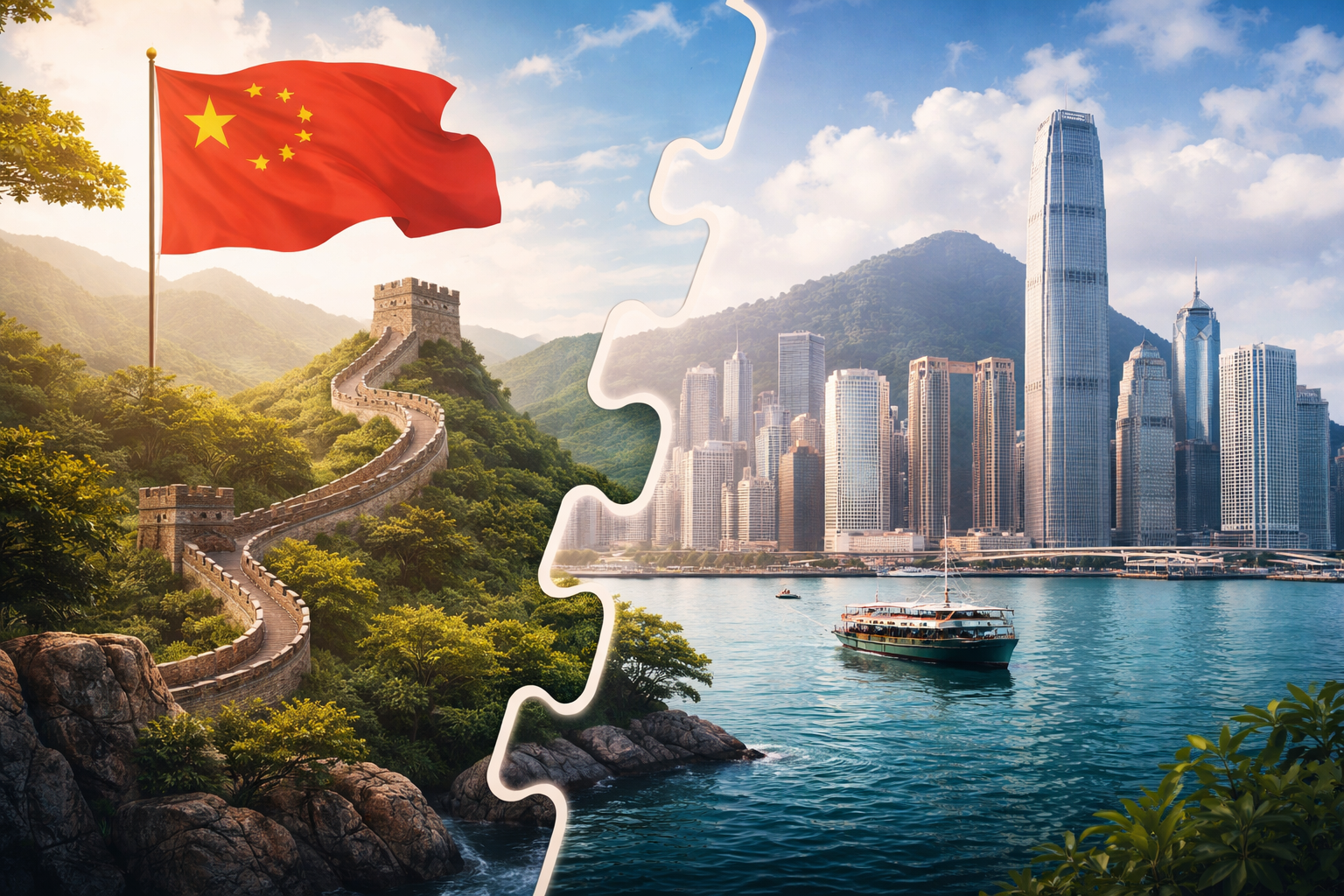
One of the most common questions entrepreneurs and investors ask is: Is Hong Kong China, or is it a separate country?
One of the most common questions entrepreneurs and investors ask is: Is Hong Kong China, or is it a separate country?
Formally, Hong Kong is part of the People's Republic of China. In practice, however, it operates under a unique model: within one sovereign state, there exists a territory with its own legal system, currency, financial regulation, and administrative structure. This is why many people feel they are entering a “different jurisdiction,” even though geographically they remain in China.
Since 1997, Hong Kong has functioned as a Special Administrative Region under the principle of “One Country, Two Systems.” Prior to that, it was under British rule for more than 150 years. The British legacy is still visible in its legal architecture: Hong Kong follows the common law system, judicial practice is based on precedent, and English is used alongside Chinese in courts, legislation, and corporate documentation.
The differences are not merely formal. Anyone who has crossed the border from mainland China into Hong Kong can immediately notice how quickly the administrative, business, and everyday environment changes. Even internet access highlights the distinction: in mainland China, access to many international services and social media platforms requires a VPN, whereas in Hong Kong such restrictions do not apply. This is one of the clearest examples of how digital regulation differs despite being within one country.
In mainland China, the official language is Putonghua (Mandarin), while in Hong Kong the primary spoken language is Cantonese. English is widely used in business, banking, legal practice, and government institutions. Additionally, Hong Kong uses traditional Chinese characters, whereas mainland China uses simplified characters. This cultural distinction reinforces the region’s separate identity.
Historically, Hong Kong developed as a trading and financial hub. After the Chinese Civil War in the mid-20th century, a large number of entrepreneurs and families relocated there from the mainland. The population grew rapidly, while the region’s territory remained limited by mountains and protected natural areas. As a result, the city developed vertically.
Today, Hong Kong ranks among the world leaders in the number of skyscrapers. Its dense high-rise development is not a stylistic choice but a consequence of limited land. This also explains its real estate market: the region is regularly listed among the most expensive in the world. Apartments are often significantly smaller than in other major Asian cities. Subdivided flats—apartments split into very small living spaces—are common. In the past, Kowloon Walled City became a symbol of extreme density, long considered one of the most densely populated places on earth.
At the same time, Hong Kong is not only about concrete and glass. A significant portion of its territory remains green, and within a short trip one can reach the sea or the mountains. The contrast between a global financial center and natural landscapes is one of the region’s defining features.
From a financial perspective, Hong Kong plays a crucial role in the international infrastructure connected to China. It is the largest offshore yuan (CNH) center, while the onshore yuan (CNY) is used within mainland China. This makes the region a key channel between the Chinese economy and global capital markets.
Trust law also deserves particular attention. Since the legal system is based on the English tradition, trust structures are widely used in Hong Kong for asset structuring, estate planning, and private wealth management. For high-net-worth families and entrepreneurs, the region remains a potential jurisdiction for such structures—subject to proper legal and tax assessment.
Hong Kong also maintains a separate immigration system and its own passport for permanent residents. Crossing the border with mainland China involves full border control procedures. In international trade, the region participates as a separate customs territory and is an individual member of the World Trade Organization under the name “Hong Kong, China.” The Hong Kong Stock Exchange remains one of Asia’s largest platforms for equity listings and capital raising.
There is also a difference in the approach to digital assets. In mainland China, cryptocurrency transactions are subject to strict restrictions. In Hong Kong, a licensing and regulatory framework for virtual asset service providers has been introduced, allowing activity in this sector within a defined compliance structure.
So, is Hong Kong China? Legally — yes. But in legal, financial, and administrative terms, it operates as a distinct system within the state. This structure explains why the status of Hong Kong is almost always a key consideration when structuring business in Asia: it directly affects banking processes, currency operations, transaction regulation, and asset protection strategies.
Since 1997, Hong Kong has functioned as a Special Administrative Region under the principle of “One Country, Two Systems.” Prior to that, it was under British rule for more than 150 years. The British legacy is still visible in its legal architecture: Hong Kong follows the common law system, judicial practice is based on precedent, and English is used alongside Chinese in courts, legislation, and corporate documentation.
The differences are not merely formal. Anyone who has crossed the border from mainland China into Hong Kong can immediately notice how quickly the administrative, business, and everyday environment changes. Even internet access highlights the distinction: in mainland China, access to many international services and social media platforms requires a VPN, whereas in Hong Kong such restrictions do not apply. This is one of the clearest examples of how digital regulation differs despite being within one country.
In mainland China, the official language is Putonghua (Mandarin), while in Hong Kong the primary spoken language is Cantonese. English is widely used in business, banking, legal practice, and government institutions. Additionally, Hong Kong uses traditional Chinese characters, whereas mainland China uses simplified characters. This cultural distinction reinforces the region’s separate identity.
Historically, Hong Kong developed as a trading and financial hub. After the Chinese Civil War in the mid-20th century, a large number of entrepreneurs and families relocated there from the mainland. The population grew rapidly, while the region’s territory remained limited by mountains and protected natural areas. As a result, the city developed vertically.
Today, Hong Kong ranks among the world leaders in the number of skyscrapers. Its dense high-rise development is not a stylistic choice but a consequence of limited land. This also explains its real estate market: the region is regularly listed among the most expensive in the world. Apartments are often significantly smaller than in other major Asian cities. Subdivided flats—apartments split into very small living spaces—are common. In the past, Kowloon Walled City became a symbol of extreme density, long considered one of the most densely populated places on earth.
At the same time, Hong Kong is not only about concrete and glass. A significant portion of its territory remains green, and within a short trip one can reach the sea or the mountains. The contrast between a global financial center and natural landscapes is one of the region’s defining features.
From a financial perspective, Hong Kong plays a crucial role in the international infrastructure connected to China. It is the largest offshore yuan (CNH) center, while the onshore yuan (CNY) is used within mainland China. This makes the region a key channel between the Chinese economy and global capital markets.
Trust law also deserves particular attention. Since the legal system is based on the English tradition, trust structures are widely used in Hong Kong for asset structuring, estate planning, and private wealth management. For high-net-worth families and entrepreneurs, the region remains a potential jurisdiction for such structures—subject to proper legal and tax assessment.
Hong Kong also maintains a separate immigration system and its own passport for permanent residents. Crossing the border with mainland China involves full border control procedures. In international trade, the region participates as a separate customs territory and is an individual member of the World Trade Organization under the name “Hong Kong, China.” The Hong Kong Stock Exchange remains one of Asia’s largest platforms for equity listings and capital raising.
There is also a difference in the approach to digital assets. In mainland China, cryptocurrency transactions are subject to strict restrictions. In Hong Kong, a licensing and regulatory framework for virtual asset service providers has been introduced, allowing activity in this sector within a defined compliance structure.
So, is Hong Kong China? Legally — yes. But in legal, financial, and administrative terms, it operates as a distinct system within the state. This structure explains why the status of Hong Kong is almost always a key consideration when structuring business in Asia: it directly affects banking processes, currency operations, transaction regulation, and asset protection strategies.