
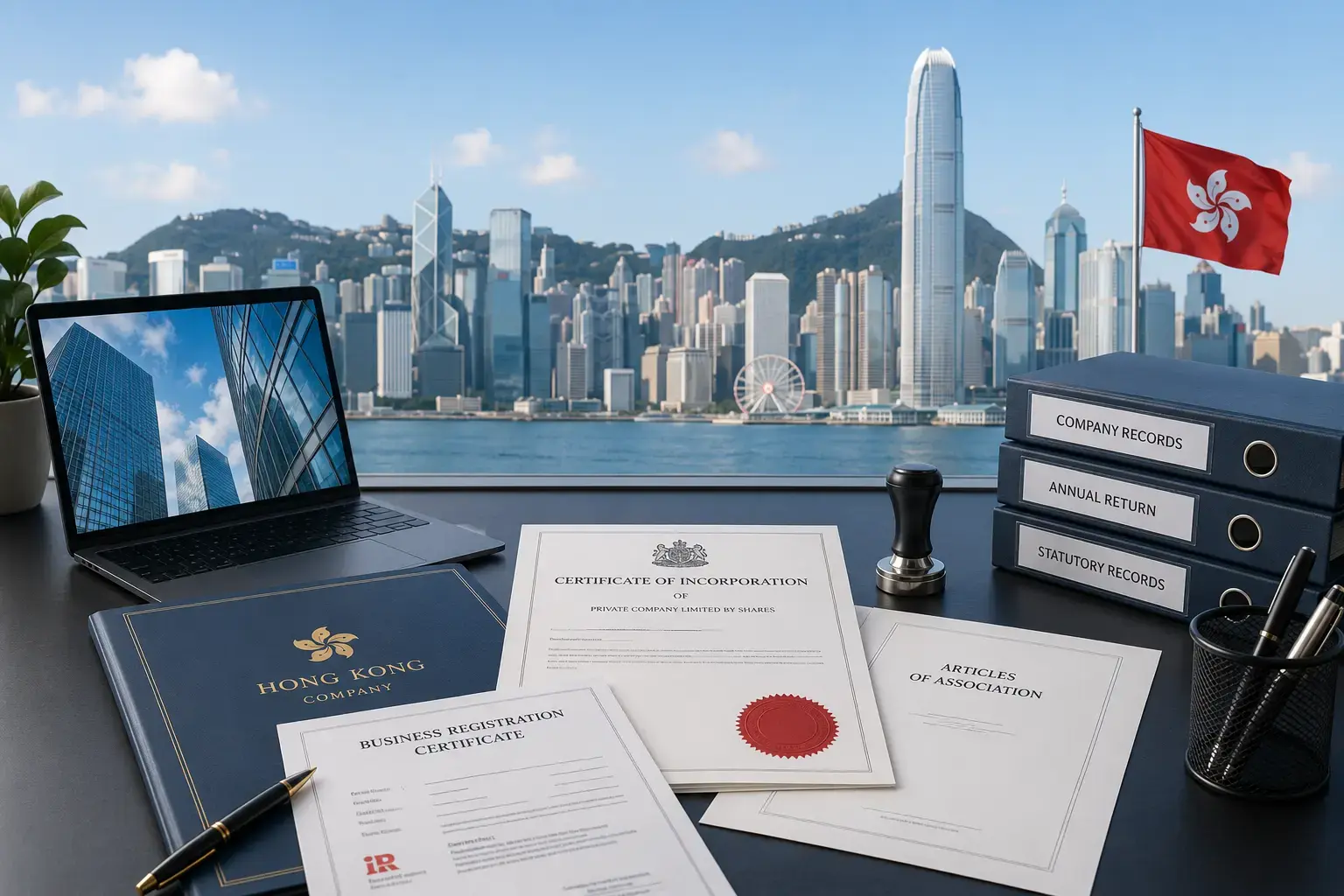
Hong Kong remains one of the most attractive jurisdictions for international business. Territorial taxation, no VAT, no currency controls, a trusted financial hub reputation, and direct access to China and South-East Asian markets — all of this makes a Hong Kong company a highly effective vehicle for trading, fintech, and consulting businesses alike.
This guide covers everything you need to know: from requirements and documents to what happens after registration and how to avoid penalties from government authorities.
Why Entrepreneurs Choose Hong Kong
- Low taxes. The corporate profits tax rate is 16.5%, and only income sourced in Hong Kong is taxable. The first HKD 2 million of profit is taxed at a reduced rate of just 8.25% — most small and medium-sized businesses never exceed this threshold. There is no VAT.
- Simple ownership structure. A minimum of one director and one shareholder is sufficient, with no residency requirements — any foreign national can incorporate a company.
- Fully remote procedure. No in-person visit or video call is required — you only need to send the signed original documents to Hong Kong by courier.
- High trust from banks and partners. A Hong Kong company is widely recognised as a credible instrument for international settlements.
Basic Requirements for Incorporation
Before starting the process, it's important to understand the minimum conditions:
- Director — at least one, must be an individual; no residency or nationality requirements;
- Shareholder — 1 to 50, can be the same person as the director;
- Company secretary — mandatory for every Hong Kong company without exception;
- Share capital — no minimum requirement, but in practice 10,000 HKD (10,000 shares at HKD 1 par value) is standard;
- Registered address in Hong Kong — typically provided by the company secretary as part of the service.
Why You Cannot Register a Company on Your Own
This is the point that surprises most entrepreneurs: an individual cannot register a company in Hong Kong without an intermediary. By law, every Hong Kong company must have a company secretary — either a Hong Kong resident individual or an entity incorporated in Hong Kong.
Since 2018, under the Anti-Money Laundering Ordinance (AMLO), any organisation providing secretarial and trust services on a commercial basis must hold a TCSP licence (Trust or Company Service Provider) issued by the Companies Registry. If a provider does not hold this licence, it is a serious red flag — they are either operating outside the law or not subject to the required compliance checks.
We hold a TCSP licence and can officially and legally act as your company secretary at every stage — from incorporation to ongoing maintenance.
What Documents You Will Need
- Passport scan of the director and shareholder — colour, photo page, minimum 300 dpi, no cropped corners;
- Proof of residential address no older than 2–3 months — utility bill, bank statement, ID card or driving licence in English;
- Selfie photo with passport, clearly showing both the face and the document details;
- Completed KYC form with 2–3 proposed company names (in order of preference) and a description of planned business activities.
If the actual place of residence differs from the passport address, a visa or residence permit will also be required.
Step-by-Step Registration Process
The entire process takes an average of 3–5 business days from the moment we receive the scans of signed documents and confirmation that the originals have been dispatched to Hong Kong. The longest part is typically not the registration itself, but the preparation stage — collecting a complete and correct document package.
Step 1. Document Request and Collection
This is the most time-consuming stage. You receive a list of required documents and a KYC questionnaire, complete them, and submit them to the provider for review.
Step 2. Preparation of Incorporation Documents
Once the document package is verified, the following documents are prepared for signing:
- Appointment of First Director — the founder appoints the director; the director accepts the appointment;
- First Board Resolution — the director confirms the company's key details: director's name, company seal, registered address, company secretary and number of shares issued;
- Articles of Association — the company's constitutional document defining its legal structure, rights and obligations of members;
- NNC1 — the primary registration form submitted to the Companies Registry, containing information about the company, its secretary and founder.
Step 3. Signing the Documents
Documents must be printed single-sided and signed in the designated places — preferably with a ballpoint pen, without date and without a printed name. The signed set is scanned into a single PDF and sent for verification.
Step 4. Sending Originals and Payment
Once the signed scans are approved, payment is made and the originals are sent by courier (DHL or EMS) to the Hong Kong office. The registration process starts once the tracking number is received.
Step 5. Company Registration
After the originals are received and the government fees are paid to the Companies Registry, the company is formally incorporated. The client receives:
- Certificate of Incorporation — confirms the company's registration (registration number, company type, official name, date of incorporation);
- Business Registration Certificate — issued by the Business Registration Office, indicating the company's address, business nature, registration number and expiry date;
- NNC1 Form — a copy of the submitted registration form;
- Articles of Association — the company's constitutional document.
A company seal is also produced, and a share certificate is issued in the shareholder's name — this needs to be signed and returned as a scan.
Step 6. Opening a Bank Account
This is often the longest stage. Banks conduct their own KYC process, so it's worth preparing a business description in advance — covering the nature of activities, expected turnover and counterparties. This significantly speeds up the approval.
What You Need to Know After Incorporation
Registration is just the beginning. Once the company is incorporated, the owner has ongoing obligations to Hong Kong government authorities:
- Annual renewal of registration and secretarial services — includes updating passport details, address and filing the Annual Return with the Companies Registry. It's best to start the process a month before the company's anniversary;
- Annual audit and filing of the Profits Tax Return (PTR) with the Inland Revenue Department — in the first year, you can choose a convenient financial year end; the return must be filed within 18 months of incorporation. Check how to choose financial year end in our guide;
- Maintaining a record of primary documents for all company transactions (incoming and outgoing invoices) — this greatly simplifies the preparation of annual accounts;
- Timely liquidation if the company is no longer needed — leaving a company dormant without formal closure will result in penalties. Check our guide about deregistration rules.
Late renewal or failure to file can result in fines from Hong Kong government authorities — in some cases reaching up to HKD 50,000.
Common Mistakes When Incorporating Without Professional Help
- Attempting to register without a company secretary — the application will simply not be accepted;
- Choosing a secretarial service provider without a TCSP licence;
- Submitting an incomplete or incorrect document package, causing the process to drag on for weeks instead of days;
- Ignoring ongoing compliance obligations, leading to penalties and the risk of the company being struck off the register.
Cost of Registering a Company in Hong Kong
Frequently Asked Questions
Do I need to travel to Hong Kong to register a company? No, the entire procedure is fully remote. No in-person visit or video call is required — you only need to send the signed original documents by courier.
Can I register a company without a company secretary? No, a company secretary is a mandatory legal requirement for every Hong Kong company. An individual cannot register a company without one.
What is a TCSP licence and why does it matter? TCSP (Trust or Company Service Provider) is a mandatory licence for any organisation providing secretarial and trust services in Hong Kong. It confirms that the provider operates legally and is subject to required compliance checks.
How long does company registration take? On average 3–5 business days from receipt of signed document scans and confirmation that originals have been dispatched. The longest stages are typically document preparation and, afterwards, bank account opening.
What documents are needed to start the registration? A passport scan, proof of residential address, a selfie with passport, and a completed KYC form with your proposed company name and business description.
Is there a minimum share capital requirement? There is no legal minimum, but in practice 10,000 HKD (10,000 shares at HKD 1 par value) is the standard.
What are the obligations after registration? Annual renewal of registration (including filing the Annual Return), annual audit and Profits Tax Return filing, and maintaining records of all company transactions.
Can I simply stop using the company if I no longer need it? No — abandoning a company without formal closure will result in penalties. A proper liquidation procedure is required to wind down the company correctly.